

We have been talking lots with parents recently about communication and listening in nursery. Here is some information about the importance of oracy in Early Years. If you have any concerns about your child’s communication and language, let us know and/or get in touch with your health visitor.
What is Oracy?
From the ESU...
In school, we use The Oracy Framework, which is made up of four strands.
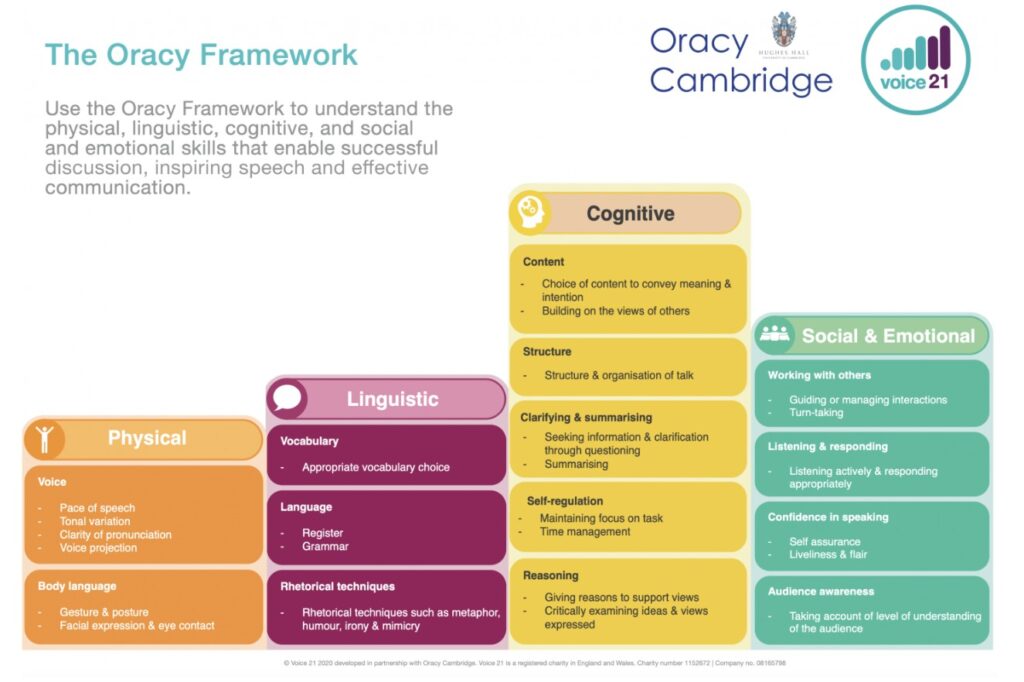
In the EYFS, there are three parts to Communication and Language:
Listening and Attention – children need to pay attention to how people are communicating in order to learn to do it themselves. They need to listen carefully to all the sounds and rhythms that make up words and sentences.
Understanding – children begin to make sense of the body language and all the words from the people around them.
Speaking – articulating ideas and expressing their own meaning to people around them, with body language and in words. (using the voice or with signs for children with speaking difficulties)
Communication and use of language has a powerful effect on your child’s life and learning:
- Communicating thoughts and feelings helps to build strong relationships with other people.
- Language is a central part of how we share information and ideas, and of teaching all subjects in school.
- Learning to read and write depends on being able to understand and use language – reading is simply a recorded form of understanding language, and writing is recording what you want to say.
- Language helps children to be clear in their thinking.
- When children can say what they want and feel, it helps them to deal with frustrations and behave in more constructive ways.
The following ideas are taken from the Early Years Oracy Project:
How can you help at home?
Because parents are the most important people in a child’s life, your role is at the centre of your child’s developing language skills. Children need:
Someone to talk with:
- Talk to your child about what you are doing. The more language children hear, the
more they learn. - Let your child know that you are listening, which encourages them to express
themselves. Follow your child’s lead by responding to what they say. - Spend time together, face-to-face, enjoying chatting.
- Take turns in ‘conversations’. Respond to what your child says to keep the conversation going by making comments of your own. Avoid too many questions.
- Turn off the TV and other distracting sounds. Children learn to communicate with real
people, and not from media – and background noise can get in the way of their ability to
pay attention and listen to talk.
Something to talk about:
- See everyday activities as talking times. A world of words is waiting in the
washing-up, going to the shops, getting dressed and so on. Going out and
about can also offer rich occasions for talk, but for a small child there is interest
and a language opportunity in everything they do. - Play with your child. Children want to communicate about what interests
them, and play is most interesting of all. - Songs and rhymes are great opportunities to use and play with language. As
well as traditional ones, you can use any you know – or make one up, and
change it as you like. - Books bring all sorts of things into the cosy space on your lap. You don’t have to
read all the words, but you can talk about whatever your child finds interesting
in the pictures. - Most of all enjoy the time you spend together for the closeness and fun it
brings – also knowing that all types of communication, from silly chatter and
jokes to serious thinking about something that puzzles or worries your child, are
laying foundations for your child’s success in the future. - Walking to school – use this time to talk about what you can see on
your walk or drive to school; houses, church, mosque, park, different vehicles.
Build on and extend the children’s basic sentences/words. - Bath time – talk through what the toys are doing, practical language of
sinking, floating and capacity or an opportunity to talk about their day or
something important to them - Bedtime – set some time aside for your child to process their day by
talking about it. You might start by sharing your day too. - Dinner time – setting the table, helping to cook, wash up or put things
away. - Shopping – give children a list of items that they can find for you in the
shop. Encourage counting/weighing and give specific instructions for
them to follow. Name all the things you are putting in the trolley and talk
about size, amount, colour, shape and how they feel.