

“Mathematics is a creative and highly interconnected discipline that has been developed over centuries, providing the solution to some of history’s most intriguing problems. It is essential to everyday life, critical to science, technology and engineering, and necessary for financial literacy and most forms of employment. A high-quality mathematics education therefore provides a foundation for understanding the world, the ability to reason mathematically, an appreciation of the beauty and power of mathematics, and a sense of enjoyment and curiosity about the subject.“
– National Curriculum, 2021
Intent:
Mathematics is a means of communicating using not only words but symbols. It is a universal language and our understanding of it should be a natural part of our experiences and development. A high-quality mathematics education therefore provides a foundation for understanding the world, the ability to reason mathematically, an appreciation of the beauty and power of mathematics, and a sense of enjoyment and curiosity about the subject.
The 2014 National Curriculum for mathematics aims to ensure that all children:
- become fluent in the fundamentals of mathematics.
- can reason mathematically.
- can solve problems by applying their mathematics to a variety of routine and nonroutine problems.
“Mathematics is a creative and highly interconnected subject in which pupils need to be able to move fluently between representations of mathematical ideas.”
– National Curriculum, 2014
It is our intention at Newham Bridge Primary School:
- to build upon the mathematical knowledge already acquired before our children start school.
- to help our children acquire a sound understanding of the basic mathematical skills and become fluent in them.
- to consolidate learning through practical skills.
- to relate basic skills to problem solving and reasoning problems.
- to develop the power of logical reasoning.
- to develop positive attitudes, confidence, and enjoyment in mathematics.
- to develop resilient learners.
The mathematics curriculum will have relevance, children will be encouraged to draw upon everyday experiences and tasks will be such that the ability of each child will be recognised in order to extend the most able, encourage the average ability child and support those with learning difficulties, thus ensuring relevant adaptations are provided to promote inclusive teaching and learning.
Implementation:
Every child should experience the complete range of mathematical concepts in line with the expectations of the National Curriculum, which is set out in six strands: Number including Fractions, Algebra, Ratio and Proportion, Measurement, Geometry and Statistics. Using and applying mathematics is integrated throughout these six strands to ensure children can reason and problem solve.
Arithmetic and securing written methods of calculation is a key part of the Maths curriculum. Every day, as part of our Maths lessons, the children complete Key Instant Recall Facts (KIRF) and arithmetic. This gives them the opportunity to practise those skills and operations whilst improving their mental recall. This takes place each morning from Y1 – Y6.
In EYFS, children are now following the daily Mastering Number National Programme from the NCETM. Children will secure firm foundations in 3 key strands: the development of good number sense, build fluency in calculation and a confidence and flexibility with number. A focus has also been given on the use of appropriate manipulatives to support mathematical structures as they prepare for the KS1 maths curriculum.
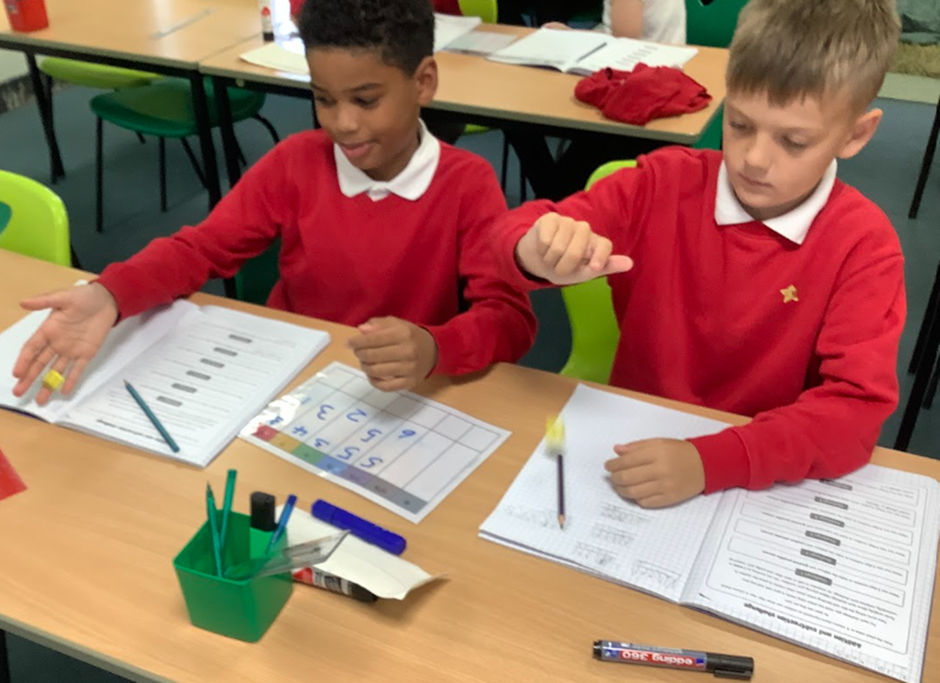
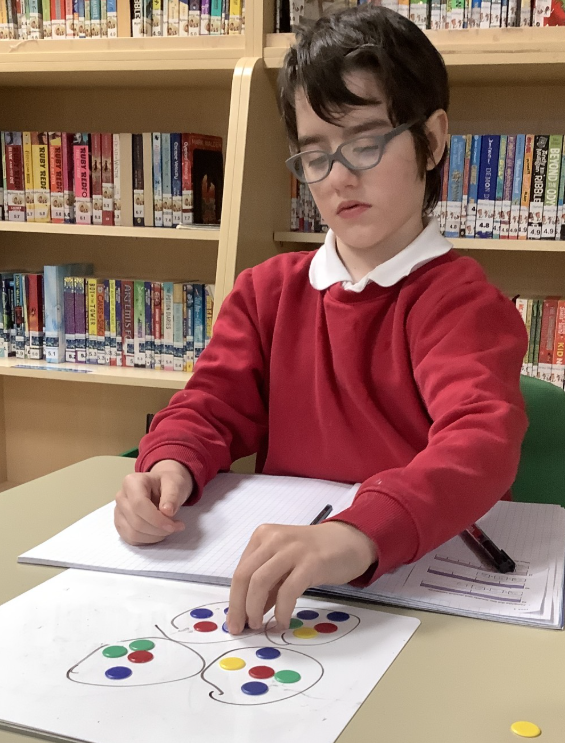
All children will follow and be taught the programmes of study from the National Curriculum 2014. Children should have opportunities for individual, group, and class work throughout their daily lessons. We use White Rose long-term planning and assessments to inform our daily planning. All lessons are personalised to meet our pupil needs from EYFS – Y6. In lessons, children may use concrete apparatus initially to develop a secure understanding of a mathematical strand before moving onto pictorial and abstract concepts.
To deliver the curriculum effectively the following types of organisation will be used:
- whole class teaching
- flexible grouping to meet pupil needs
- one-to-one
Class teachers understand the need to work flexibly and are continually assessing and intervening throughout lessons to support all children. Teaching assistants can be used to work in small group situations.
“Children’s chances of success are maximised if they develop deep and lasting understanding of mathematical procedures and concepts.”
– NCETM
Therefore, in September 2024, we began working with Archimedes Maths Hub as a Teaching for Mastery School. This means our teaching and learning approach has been strengthened using national best practice and principles which help children to build strong foundations and a deep understanding linked to a teaching approach of the Five Big Ideas: Representation and Structure, Mathematical Thinking, Fluency, Variation and Coherence. Mastering maths means pupils of all ages acquire a deep, long-term, secure and adaptable understanding of the subject where they can make connections between their learning and articulate their understanding with confidence.
In every maths lesson, a love of maths is felt by both staff and children as they celebrate learning together, build resilience and motivation to continue their learning beyond the classroom door. This passion is identified with the children using the ‘Mathematician of the Day’ Cape or Sash, whereby teachers explain their reasoning for the reward.
Mathematics is not a subject in isolation; it is an integral part of the whole curriculum:
- Developing appropriate language – English
- Applying measurements and calculations during investigations – Science
- Reading grids and co-ordinates from maps – Geography
- Dates, time, and Roman Numerals when accessing timelines – History
- Measurements in planning – Design and Technology
- Identifying musical patterns – Music
- Physical knowledge of direction and angles during sports activities – P.E.
- Collecting and classifying data – Computing
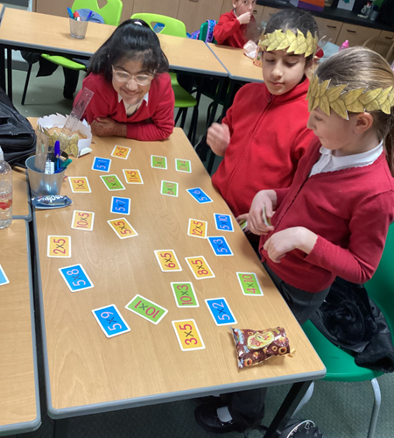
It is vital valuable time is given to the understanding of mathematics through practical activities wherever appropriate and that as teachers we encourage independence in the skills of investigating and problem solving. Investigations can be spontaneous and should be recognised and pursued at the time they occur.
Impact:
The assessment, recording and reporting process will follow the whole school policy. Impact is evident in the children’s knowledge and understanding when our children demonstrate they know more, remember more, and do more in they daily lessons and application of maths in the wider curriculum.
We developed an assessment tracking system to suit the needs of our school in two areas of mathematics: KIRF and WhiteRose National Curriculum Objectives from our long-term scheme of planning. Both staff and children are confident when using the system. Each child has a tracking grid, which is found in the front of their exercise books for Maths, back of their arithmetic books for their KIRF. The grids are continually updated and used to inform next steps in learning. These grids then form part of our termly judgements. As a school we moderate termly the children’s learning and formalised assessments to plan interventions, next steps and make assessment judgements.
Where possible, marking is conducted live in class with the child and instant feedback and intervention is put in place during the lesson for the child to make progress and access the lesson. When marking activities and tasks at the end of the session, C.O.W marking is used consistently across school.
- C: Correct your work. The child works in green pen to correct any mistakes or misunderstandings from the previous lesson.
- O: Own it. The child has displayed a good understanding of the concept covered and is given a problem linked to the previous lesson to extend their understanding further. This also checks a child’s retention of their previous day’s learning.
- W: Work with me. The child has displayed limited understanding from the previous lesson and may need extra support from the class teacher or TA to build a foundation of the previously taught strand.
Curriculum Resources:
Each classroom is appropriately resourced. Additional resources are stored in cupboards and bookshelves in the corridors outside of the classrooms. Children should be encouraged to value and take care of all equipment.
There is a wealth of computing resources within school to support and enhance the teaching of Maths. KS1 access ‘Numbots’ in school and at home to support their learning with number knowledge and bonds. KS2 access ‘Times table Rockstars’ in school and at home to support their learning with multiplication and division facts. Year 6 have access to ‘Maths.co.uk’ to use as a pre-assessment tool or revisit previously taught strands to assess their retained knowledge and understanding. Teachers analyse the outcomes to inform interventions and/or lessons. We also encourage children to access NRICH and other Mathematical websites through our Parental Calculation Handout.
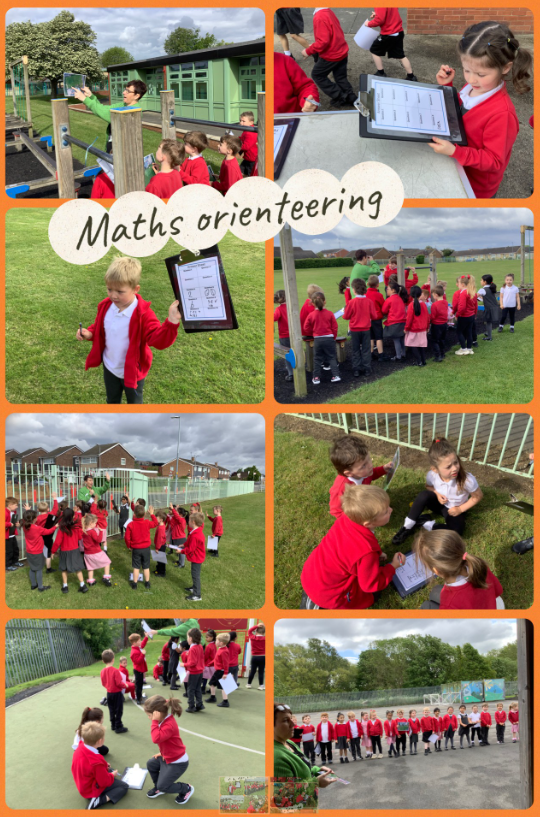
Every term Maths is celebrated throughout school in a variety of ways: working with Santander to build money knowledge in the wider community, parental calculation support sessions, NSPCC Number Fun, National Numeracy Day competitions, maths orienteering challenges, Spatial Reasoning resources, parental support to bring maths into their home (online games and board game recommendations), Times tables sing off.
Curriculum and Parents:
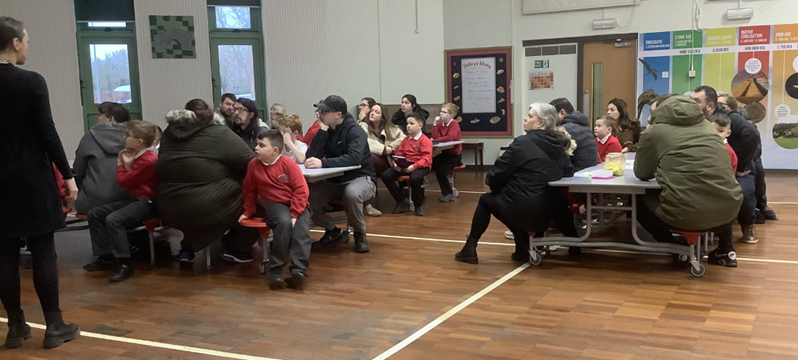
Parents are encouraged to be active participants in their child’s learning. We aim to provide an open-door policy whereby parents can seek advice or support from any member of staff. We endeavour to communicate well through newsletters, topic leaflets, homework diaries, reading journals, reports, open days, parental workshops, and the website. Furthermore, parents are invited into school during Maths celebration events to discuss methods the children use with their class teacher and provide opportunities for learning Maths at home.
Homework is given throughout school to consolidate work undertaken in class. Regularity and amount of homework differs throughout school, but we endeavour to give one piece of Maths homework per week. Year 6 operate a homework club after school to support .
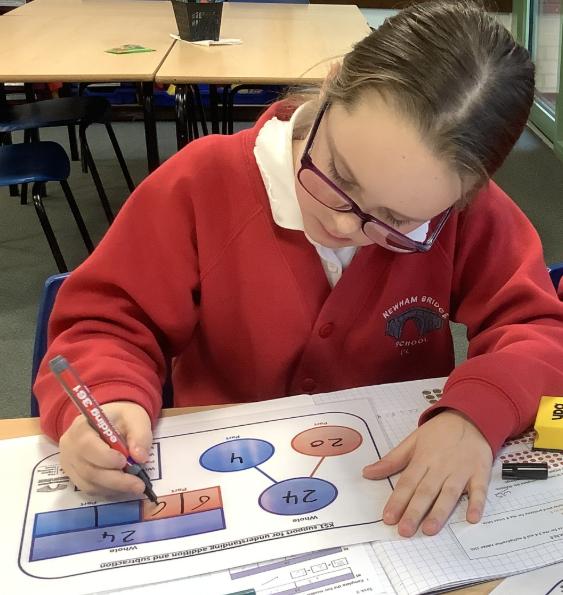
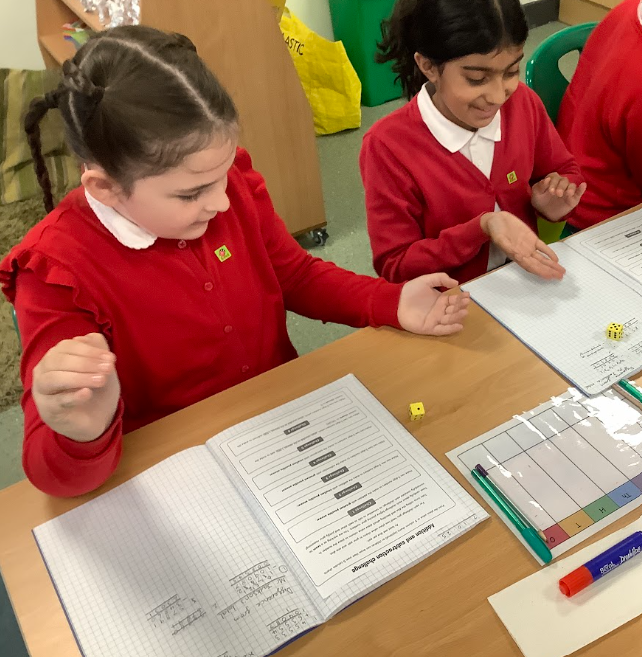
Examples of Maths in school:
| Useful websites to access at home: | |
| KS1 & KS2 – Topmarks | https://www.topmarks.co.uk/maths-games/5-7-years/counting |
| KS1 & KS2 – Mathsframe | https://mathsframe.co.uk/en/resources/category/22/most-popular |
| KS1 – Numbots | Numbots Game |
| KS2 – TTRS | Times Tables Rock Stars: Play |
| KS2 – Guardians: Defender of mathematica | https://www.bbc.co.uk/bitesize/topics/zd2f7nb/articles/zn2y7nb |
| KS2 – Maths.co.uk | https://www.maths.co.uk |
| EYFS, KS1 & KS2 – WhiteRose | https://whiteroseeducation.com/parent-pupil-resources/maths/free-downloads#download |
| EYFS, KS1 & KS2 – Nrich | Parents | NRICH Primary Students | NRICH |